Monday, 28 December 2015

How Young They Died

This evocative novel, published in 1969, is set in England and on the Western Front between 1914 and 1918. Much of what is described in the novel is informed by the author’s own experience of the war. Although much of the war narrative is serious and sombre, there are also several scenes of black humour. The central character, James Hilton, turns 19 in the summer of 1915. He arrives in Flanders with the Wiltshire Light Infantry in April 1916. As in the author's war experience, he is twice invalided home, being wounded first at the Somme and again in the summer of 1918. The novel ends with his marriage on 11 November 1918 to one of the nurses who treated him in hospital (so also did the author marry one of his nurses).


The author, Stuart Cloete (born 23 July 1897), was born in France to a South African family. He was educated in Lancing College, Sussex and served in the school’s officer training corps. He went to Sandhurst and in September 1914 received a commission as a second lieutenant in the 9th Battalion, King's Own Yorkshire Light Infantry. On being wounded in August 1916 he was invalided to London. He later returned to the Western Front with the Coldstream Guards and was severely wounded in the attack on Saint-Leger in August 1918. After the war he settled in Transvaal but in the mid 1930s abandoned his farm and his failing marriage to return to England to launch a career as a writer. His first novel, Turning Wheels, was published in 1937 and was very successful. He went on to write a further 13 novels, numerous volumes of short stories, a two-volume autobiography and several other works on non-fiction.

For much of the war Jimmie Hilton pursues a relationship with a London prostitute called Mona. She befriends numerous soldiers in the war and sends them food packages when they are at the front. At one point at the Somme he merges his thinking about Mona with the senses and shapes of warfare:
“He thought of Mona... But what was the good of thinking about them? Of aching for it? Still, you had to think of something and it was better than thinking about the war. Food, books, pens, paper, rifles, bombs, women. He thought of all the things a man touched and held in his hands! The soft nose of a horse, the soft thighs of a girl. He thought of Mona's thighs. Hands and fingers had a kind of life of their own. The hard, cold feel of a Mills bomb; its weight. The weight of Mona's breasts when he came up behind her and held them. The hard, smooth feel of a rifle-butt and the cold of its barrel. The softness of a woman's belly, the wiry harshness of her pubic hair. The messages the hands flashed back to the brain; the return messages from the brain to the body, every man his own bloody signal corps.”

Sunday, 6 December 2015

The Eighth Day

This epic novel, published in 1967, won the National Book Award for fiction. Its central setting is a small mining town in southern Illinois but there are also sections of the novel set in Chicago, New Jersey, Ohio and in Chile. The central character, John Ashley, works in the local coal mine and the novel gives an account of the life of his family from 1885 to 1905, the plot being shaped around the 1902 murder of Ashley’s neighbour Breckenridge Lansing for which he is found guilty and sentenced to death. The author weaves the narrative in five non-sequential sections rather than in a simple chronology. By doing so, he reveals elements of the case of the killing of Breckenridge Lansing throughout the novel as he gives an elaborate account of the lives led by this small-town family before and after the crime.


The author, Thornton Wilder (born 17 April 1897), was the recipient of three Pulitzer Prizes, one for fiction and two for drama. He was educated in China, where his father served as a diplomat, and California. He served in the Coast Artillery Corps from September to December 1918 before completing a degree in Yale. His first play was published in 1920 and his first novel in 1926 while he was working as a French teacher in a preparatory boarding school in New Jersey. His second novel, The Bridge of San Luis Rey, won the Pulitzer Prize for fiction in 1928. One reviewer was effusive in his appreciation of Wilder’s talent:
“Mr Wilder knows precisely what he is doing and why; and, better still, how to do it. This is lavish, yet restrained, praise for a tale which I am grievously tempted to call a masterpiece.” It was this precision that characterised Wilder’s finest writing.

The most striking aspect of this novel is how the author, with a mindset shaped by World War, depicts two key attempts to save a life as futile. The murder of Breckenridge Lansing we learn is an attempt to save John Ashley. Instead he is sentenced to death. Likewise when John Ashley is identified as a fugitive while in exile in Chile, an English woman conspires to rescue him. He had previously been rescued from the train that was bringing him to be executed. Understanding him to be innocent and honourable, the reader has been taught by the author to identify with Ashley and is looking forward to the prospect of him being safely reunited with his wife and children. All the efforts to save Ashley are, however, ultimately in vain. Similarly many soldiers were dramatically saved in battle only to be killed a short time later. The author, however, goes on to show the success of his children after the loss of their father.

To a great extent Wilder uses this novel to reflect on the concept of history: personal history, family history, local history and national history. Towards the end of the narrative he reflects on the history of Coaltown, the small town at the centre of the novel:
“Here the young John Ashleys had descended from the train and looked about them, all happy expectation. The platforms of railway stations! ...Here young men departed for the First World War and returned from it. Before the second war a new highway had been built and new tracks laid eleven miles to the west of Coaltown. The station fell into disrepair. It decayed and finally went up in flames one frosty November night. It burned up, like everything else in history.”

Friday, 4 December 2015

On Gallipoli: an epic of Anzac

This epic narrative poem, written in 1931 and published in 1958, is a fictionalised account of the experience of a group of young Australians at Gallipoli. Though there is presumably much autobiographical content (“I was 18… yet I felt tired and old”), many of the scenes take place before the author arrived at Gallipoli. The narrator and central character is Bill, a past pupil of Sydney High School. He describes landing on the beach with his unit and then the various battle scenes that led to the death of several of his friends. The text is accompanied by poignant sketch illiustrations. The narrative concludes with the humiliating evacuation of the beleaguered forces mainly due to the severity of the winter weather.


The author, Richard Graves (born 17 July 1897), was born in Waterford. Following the death of his mother in 1909, his father emigrated to Australia. The author was left in the care of his paternal grandmother and sent to boarding school in Dublin. He left Ireland to join his father in Queensland in 1911. He attended agricultural college before serving with the Kennedy Regiment in northern Queensland. A few weeks after his 18th birthday he volunteered for active service and embarked with reinforcements on 16 August 1915.  He served as a Private in the 25th Battalion of the Australian Infantry and was wounded at Gallipoli on 23 November. He was evacuated to a military hospital in Malta. He joined the 7th Australian Trench Mortar Battery in August 1916 and served with that unit in France for the remainder of the war. On returning to Australia he suffered from shell shock and related claustrophobia. This led him to a love for wilderness and he became an expert in bushcraft, training soldiers in survival techniques for jungle warfare in the Second World War. He wrote several books on bushcraft as well as adventure books for children.


Perhaps the most interesting aspects of the poem are the conversations with enemy soldiers. Bill’s friend Pearce encounters a wounded Turk during a short truce to retrieve dead and wounded from the battlefield:
“Why see… you talk with me and we are friends…
Between us is no feud or enmity…
The intervening war alone offends
The sense of fellowship ‘tween you and me…
What cause is this, which makes us disagree,
Fostering the fears from which we should be free?

It is not you or we who caused this war
But those who rule… not always for our good…
They never see us… wounded, mangled… sore…
They never know the horrors we’ve withstood…
Or how our wives, in dread of widowhood,
Had begged us stay… Praise Allah!... if we could.”

His cigarette had dwindled to an end.
I took it from him his almost nerveless hand…
“Comrade, that was the action of a friend…
But tell me why you come in No-Man’s-Land.
Turk and Australian… side by side you stand…
Has the war done?... I do not understand.”

Monday, 23 November 2015

Purely Academic

This satirical novel, published in 1958, is, as its title suggests, set in an American university. The central character, Henry Schneider, is a modern historian in a Midwestern university and there are interesting accounts of curriculum committee meetings and anodyne undergraduate lectures. Schneider’s a schemer and he sets about advancing his own career by pretending to be undertaking a top-secret state security role, thus rising in the esteem of colleagues and administrators alike. His specialism of diplomatic history is also put to good use in negotiating for a better salary, playing one university off against another.


The author, Stringfellow Barr (born 15 January 1897), was the son of an Anglican clergyman and grew up in Virginia and Louisiana. He studied English at the University of Virginia and after obtaining his M.A., enlisted in the army. He served with the army medical corps in France for two years. After the war he studied modern history at Oxford as a Rhodes scholar. He taught modern European history (as did the central character of this novel) at the University of Virginia from 1924 to 1936. He was president of St John’s College, Annapolis from 1937 to 1946 and was a radical innovator there, introducing the Great Books curriculum with the intention of shaping learning around the Western literary canon. He was the author of a wide variety of books, including textbooks, a cookbook and a children’s book. Purely Academic was his only novel.

Given that Henry Schneider was teaching the same subject as the author, it seems safe to presume a high degree of autobiographical content. It's likely, therefore, that the author imagined that Schneider had served in the First World War. In Chapter 14 Schneider delivers an undergraduate lecture on the First World War with considerable passion and perhaps some trauma:
“He paused and looked about him as if in sudden pain. Some of his students stared curiously. Breathing harder, he began again.
‘From this bourgeois, Baconian Eden modern man was ejected with a sudden violence unique in his experience. In a few days, millions of men were mobilised to kill and be killed. It was as if some terrible madness had seized on the citizens of the city that Matter and Force has so benignly ruled. Across the tranquil, smiling, midsummer countryside of Europe swept vast armies, bearing more deadly weapons than man had ever known. The earth rocked and the sky reeled. The great gray ships of the British Royal Navy hurried silently to their appointed posts. It was the summer of 1914.’
Suddenly such violent emotions arose in Schneider that he knew he could not go on. He glanced at his watch. There was lots of time left — but it was time he could not use. His throat became dry; his voice came to his own ears as if from a great distance. He felt slightly dizzy.
‘I cannot discuss the First World War today. I am sorry.’
He bowed slightly, rose clumsily to his feet and left his classroom.”

Friday, 13 November 2015

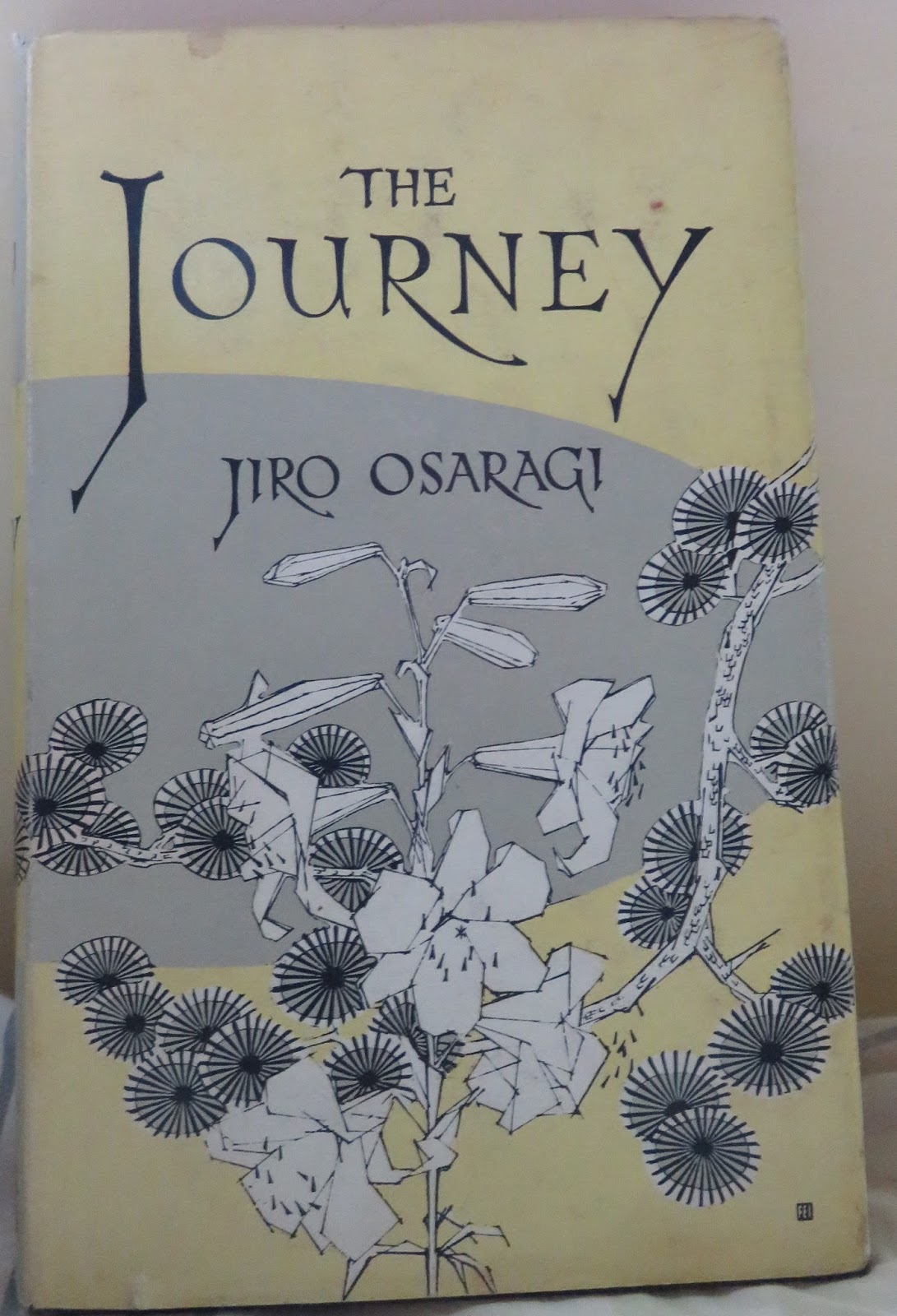
The Journey

This novel, published in 1952, is set in and near Tokyo and describes a society changed by the American occupation after the Second World War. The central character, Okamoto Taeko, is a young woman. At the start of the novel she has arrived in the seaside resort town of Kamakura to see her uncle Soroku and to visit the grave of his son Akira, who was killed in action in the war. At the cemetery Taeko meets a young man called Tsugawa Ryosuké, one of Akira’s school friends, and they fall in love. Ryosuké becomes increasingly greedy and ambitious and struggles with gambling debts and the dangers of corrupt business deals. This puts an unbearable strain on their relationship. At the end of the novel, Taeko’s journey is uncertain:
“Painful as things might be at the moment, the first consideration was life itself and the process of living. She must not stand still on the road but must keep on walking. This idea had somehow become embedded in her mind and she felt the power of it. She would not let her life become like standing water, which is bound to stagnate; no, she would make it start flowing, like a fresh river. At present her destination might be blank but she would move ahead depending on the very strength that motion gave her.”


The author, Osaragi Jirō (born 4 October 1897 as Nojiri Haruhiko), was born in Yokohama. His first book was published while he was still in school. After studying at the University of Tokyo, he took a teaching position at a girls’ high school in Kamakura, the town where most of this novel is set and where he remained for the rest of his life. Osaragi committed himself to a full-time career as a writer in 1923 and his first historical novel was published in the following year. His 1948 novel Kikyō (Homecoming) was the first to deal with post-war society and won the Japan Art Academy Prize.

What connects the key characters of the novel is the death of Akira, the only son of Okamoto Soroku. He was killed in the war in southern China. His old school friend, Ryosuké, comments to Taeko at his graveside:
“Terrible thing about his dying, isn't it? Well, that's what happens in war. I dare say it couldn't be helped. But, you know, [he] always took the most dangerous things on to his own shoulders. He was like that at school too... A terrible shame his dying like that!”
He often felt “regret that on the particular front where so few people had been killed, his friend had been one of the casualties.”
Later in the novel Akira’s father speaks of his grief:
“He’s dead and there’s no use my complaining about it. Until today I haven't ever mentioned him to anyone. But my loneliness, you know, is something indescribable. Nothing can alleviate it. It gets worse and worse as the days go by. It does no good talking to people about it. Something must be wrong with me.”


Friday, 6 November 2015

Buše and Her Sisters

This novel, published in 1953, is set in a rural community of the Klaipėda district of western Lithuania where the author grew up. The central character is Buše, one of four daughters of Mikšas Karnelis, a peasant farmer. From an early age she shows boorish determination to get her own way and has little respect for her sisters. When she marries Jokūbas Pikčiurna, she sets about transforming his small farm holding into a landed estate. At the end of novel, the author presents the anti-capitalist viewpoint on the legacy of Buše years after her death:
“Today there are no more masters in Benagiai. All trace of them is gone and their memory has faded. Today there are no more Pikčiurnas in Benagiai, even their name is gone, nobody remembers them or wishes to do so.”


The author, Ieva Simonaitytė (born 23 January 1897), grew up in a small village in the German-governed Klaipėda district of Lithuania. She was taught to read and write by her mother. In 1921 she moved to the city of Klaipėda and became involved in the fledgeling Lithuanian cultural movement. Her literary breakthrough came in 1935 with her award-winning historical novel on the Šimoniai family (Aukštujų Šimonių likimas). In old age, she returned to the district of her childhood every summer (her summer home is now a museum).

The central character, Buše Pikčiurnienė, has economic ambitions when the First World War breaks out but is furious when her elder son, patriotic for Germany due to his education, is the first to volunteer to serve in the German army:
“When war broke out in 1914 Pikčiurnienė rejoiced. She had debts and she felt war would be her salvation. And even more than that. People would be glad to work for a crust of bread now. Everyone knew that there was always hunger in war-time, and after it too!
There was only one fly in the ointment; her son Jurgis announced that he was going to volunteer for the army at once. Volunteer! He was barely 19, he would not be called up for some time yet.”
She tries to reason with Jurgis:
“D'you want to be killed like a dog out there? D'you want to have the crows pick out your eyes?”
Her predictions prove correct; Jurgis never returns.

The hero of the novel is Jurgis Būblys, husband of Trudė, one of Buše’s sisters. He comes home from the war discontent and speaking of revolution. His friend, Adomas, recalls his removal from the Western Front:
“I threw my gun away, Jurgis, in the Argonne Forest. There was a gas attack. When I came to, I knew I was in a dark forest but where I was or what had happened I could not remember...
But all the same, I felt sort of guilty. Maybe I ought to have done differently. But I didn't know how. We did know, all of us, what was happening in the East, over there in Russia. But we had nobody to start things. Only those that could talk and dream... And then when I came out of hospital, it was all over.”
Jurgis becomes the local Communist hero, people telling their grandchildren about him:
“how eagerly they listen to tales about Jurgis Būblys, who not only fought for all that the people of Benagiai now possess but gave his life for it!”

Thursday, 5 November 2015

The Second Seal

This First World War thriller, published in 1950, is one of 11 novels featuring the Duc de Richleau character. Jean Armand Duplessis, the tenth Duc de Richleau, is a French aristocrat but has been politically disgraced and is in exile. On the other side of his family, he is the Count Königstein, giving him strong connections to Austria-Hungary and to the wider German-speaking aristocracy. He’s also related on the maternal side to the Russian royal family. As a career soldier, he served in the Ottoman army during the Balkan wars and in one incident saved the life of a senior Serbian officer. He has taken British citizenship in admiration of the strong principles of the Empire. With a foot in almost every camp as the outbreak of the First World War looms, he’s sent by the British authorities to Belgrade to investigate the activities of the ultranationalist secret society, the Black Hand. He ends up trying to prevent the assassination of Franz Ferdinand in Sarajevo. On the outbreak of war, he retained his officer’s rank in the Ottoman army, and had been offered senior military positions in Serbia, Austria and Britain. Through his Austrian role, he visits the German military headquarters in Aachen in an attempt to persuade von Moltke to move German forces from the Western Front to the Eastern Front, allowing the French and British forces to recover from the initial onslaught. Added to all of this confusion is his clandestine affair with Archduchess Ilona Theresa, granddaughter of Emperor Franz Josef of Austria.


The author, Dennis Wheatley (born 8 January 1897), grew up in London. He fought in the First World War as a lieutenant in the Royal Field Artillery. He dedicated this novel to “the memory of that fine soldier and friend, the late Colonel H.N. Clarke” and for “those good companions of my youth, J. Albert Davis and Douglas Gregson” and for “those other officers, N.C.O.s and men with whom I had the honour to serve in the 2nd/1st City of London Brigade R.F.A. from September 1914”. He served in Flanders from August 1917 to May 1918 before being invalided out of the war. He began writing short stories in the 1920s and his first novel, featuring the Duc de Richleau, was published in 1933.

In an early scene in the novel, the central character is in London in April 1914 and explains to a senior British official his desire to serve in the British army:
“since I am debarred from fighting for the country of my birth, I wish to fight for the country of my adoption. I arrived in England yesterday with the hope that I should be in ample time to make arrangements which would ensure my being in a post suited to my abilities when war breaks out.”
When war does break out, he’s in Vienna observing the mobilisation of troops:
“Meanwhile bodies of smiling troops swung through the streets, lustily singing gay marching songs. The great majority of them were reservists, or young conscripts, on their way to training camps, where they would spend several weeks, if not months, being knocked into shape before they were called on to face the enemy... De Richleau watched it all with unsmiling eyes. He was no pessimist by nature but ever since he had reached manhood war had been his game. He had seen too many youngsters, grinning, vigorous, determined at one moment, and screaming like maniacs from shell-rent flesh or smashed bone the next; too many still, twisted corpses and pulped, messy heads. But his own effort to prevent the colossal madness had failed.”